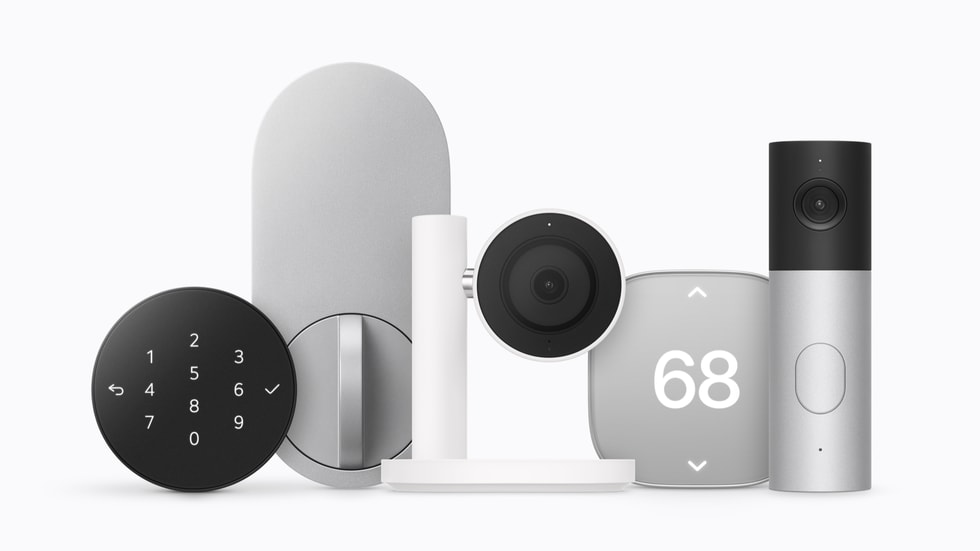
There are countless write ups on Apple’s new hardware entries into the smart home market. We’ll try to break down the hardware in a concise and pragmatic fashion. Note that Apple has partnered with a LG and Schneider Electric on Matter devices; there is a new NFC driven tap to add, but otherwise those devices come with Apple’s seal of approval but not their industrial design.
Apple HomeView
First Take
The biggest question mark and novelty. Apple has joined the ranks of the Amazon Echo Show and the Google … Nest Hub? This stands as the only clear fact about the HomeView. It sets on top of a grey mesh speaker and can switch profiles on the fly with facial recognition. Some or all of this will rely on a user having an iPhone. The HomeView looks like an expanded Apple Watch but its app ecosystem keys around Apple CarPlay, a platform notable for its lack of video applications. It will work with HomeKit Secure Video but not with the massive install base of Ring cameras. The HomeView will work as a Thread border router but does not claim any smar thome device features beyond what you normally get with Apple Home on your iPhone or iPad.
Should I buy it?
If you have faith in Apple’s ability to iterate on an app platform that isn’t fully baked at launch, trust that Siri will continue gaining smarts, and can stomach a $299, this might be for you. Skeptics should wait a year to see how it develops.
HomePod mini 2
First Take
It ships with a new processor, which will presumably help with Siri AI (launching at a future time). It has “Sound Glow” that matches the color palette of your album artwork (??). It supports newer wireless standards such as Wi-Fi 6E (no 7, but it only streams audio) and Bluetooth 6, and can connect more easily to your Mac, and can be used in a 4.0 surround configuration with the 4th generation Apple TV 4K.
Should I buy it?
Worth a look if you enjoy the new colors (pepto pink anyone?) or want to kit out extra rooms with a more future proofed speaker. The surround functionality could be good if you are fully in with Apple ecosystem, but keep in mind the 4 speaker configuration only works to expand a stereo system with full HomePod 2nd gen speakers, not the HomePod mini 1.
Apple TV 4K (4th gen)
First Take
This comes with a touch-enabled clickpad and a microphone on the remote. It also includes built in far field microphones on the box itself, giving you Siri control if you favor non Apple speakers in your home theater.
Should I buy it?
If you are 2 generations behind, want to limit companies’ ability to spy on your viewing habits, or really want an integrated Siri experience with your media streamer, it might be worth a look. At $299 the value proposition wears thin unless a new killer feature emerges.
LG Video Doorbell
First Take
It’s worth mentioning LG’s recent kerfuffle when it comes to sending user data from their televisions. There is some irony in Apple, a company touted for their privacy mindset, with LG, whose PR campaign was akin to a 5 year old vociferously shaking their head when confronted with wrongdoing. The doorbell looks minimalist and stately enough, coming in dark grey, and lighter grey. Users whose doors aren’t specced to their MacBook may not enjoy the aesthetics. Recording and AI analysis come from Apple HomeKit Secure Video and Apple Intelligence, which may not match Ring’s feature set but may be a preferable walled garden. Integrations abound, with videos displaying your Apple TV, doorbell rings on your HomePods, and door unlocking with LG’s other offering.
Should I buy it?
If you enjoy the asesthetics, have an existing power line, and believe more in the power of Apple’s ecosystem than LG’s latest security foibles. At $249, you may want to look to Aqara for more cost effective doorbells and cameras in the Apple ecosystem.
LG Smart Deadbolt Lock
First Take
This lock presents the usual chunky interior oval, but the exterior circular number pad may an acceptable minimal presentation for your exterior. The lock supports UWB for hands free unlocking that using directional location to ensure unlocks are purposeful. It can also unlock via NFC, PIN code, and a physical keyhole. It does not have a fingerprint sensor or other biometric approaches, and while its Aliro support promises to support Android stalwarts, support from companies such as Google and Samsung has been lacking for UWB unlocks.
Should I buy it?
The minimal exterior might help the spousal acceptance factor, but LG has no track record in this category that presumes to protect your house. While breaking windows presents as a more typical risk than your smart lock, the $349 price tag and lack of history may give buyer’s pause. Integration with Apple and the doorbell helps to boost its case.
LG Smart Thermostat and Schneider Home Smart Thermostat
First Take
Both of these clock in at $199, have a white exterior and large LCD display, and support Apple’s Adaptive Temperature. Your choice might come down to aesthetics (Schneider is a rounded square, while LG continues the circular route). Both can sync with a home room sensor that share the same shape and a $40 price tag.
Should I buy it?
While smart thermostats have been a category since Nest launched their essential initial offering in 2011, these offerings extend the Matter set of offerings in ways that Ecobee and Nest lack. Room sensors can greatly help the issue of room temperatures being wildly out of balance, and the price is not out of line with other proprietary offerings. Aesthetics may guide your choice, though Schneider’s long existing experience with circuit breakers and home automation tip the reliability estimation in their favor.
LG Assorted Smart Cams
First Take
LG rounds out the video offerings with a Floodlight Cam, Outdoor Cam, and Indoor Cam. These offer the same HomeKit Secure Video and Apple Intelligence integration as the doorbell. They tick the usual boxes, though the Indoor Cam claims to intelligently look away when a registered user enters the home (a legitimately valuable feature, though why these companies can’t mechanize a privacy lens remains puzzling). None of the cameras offer battery functionality; you’ll need USB-C to power the indoor cam, USB-C for the outdoor cam, and a hardwire AC connection for the Floodlight Cam.
Should I buy it?
If you are bought into the Apple and LG partnership, can ignore some initial eye watering prices, and don’t mind some electric cabling chores, then buy these to dot around your home. The Floodlight Cam tips in at $400, the Outdoor Cam at $300, and Indoor Cam at $200.
Did Apple revolutionize the Smart Home?
Almost certainly not. Apple is partnering with ADT to install these devices, a company (hat tip to The Verge) that will be happy to upsell you on their security system … based on the Google platform. Any effort that expands the circle of trust for wary users who want to get into Smart Home technology is welcome, and Matter over Thread can use any boost it can get. The HomeView has intriguing potential, especially with its multiple profile support, but much of the promise of this launch will need to be watched over months, if not years. The LG Smart Lock gives me hope for future form factors (given the bulk of the Aqara UWB U400 offering), but its launch in December is a sliver of time before the CES rush of new product announcements. For now Apple is improving the smarts of your home, but not defining the category.


Leave a Reply